
What a Civil Engineer Really Balances in West Texas Land Development
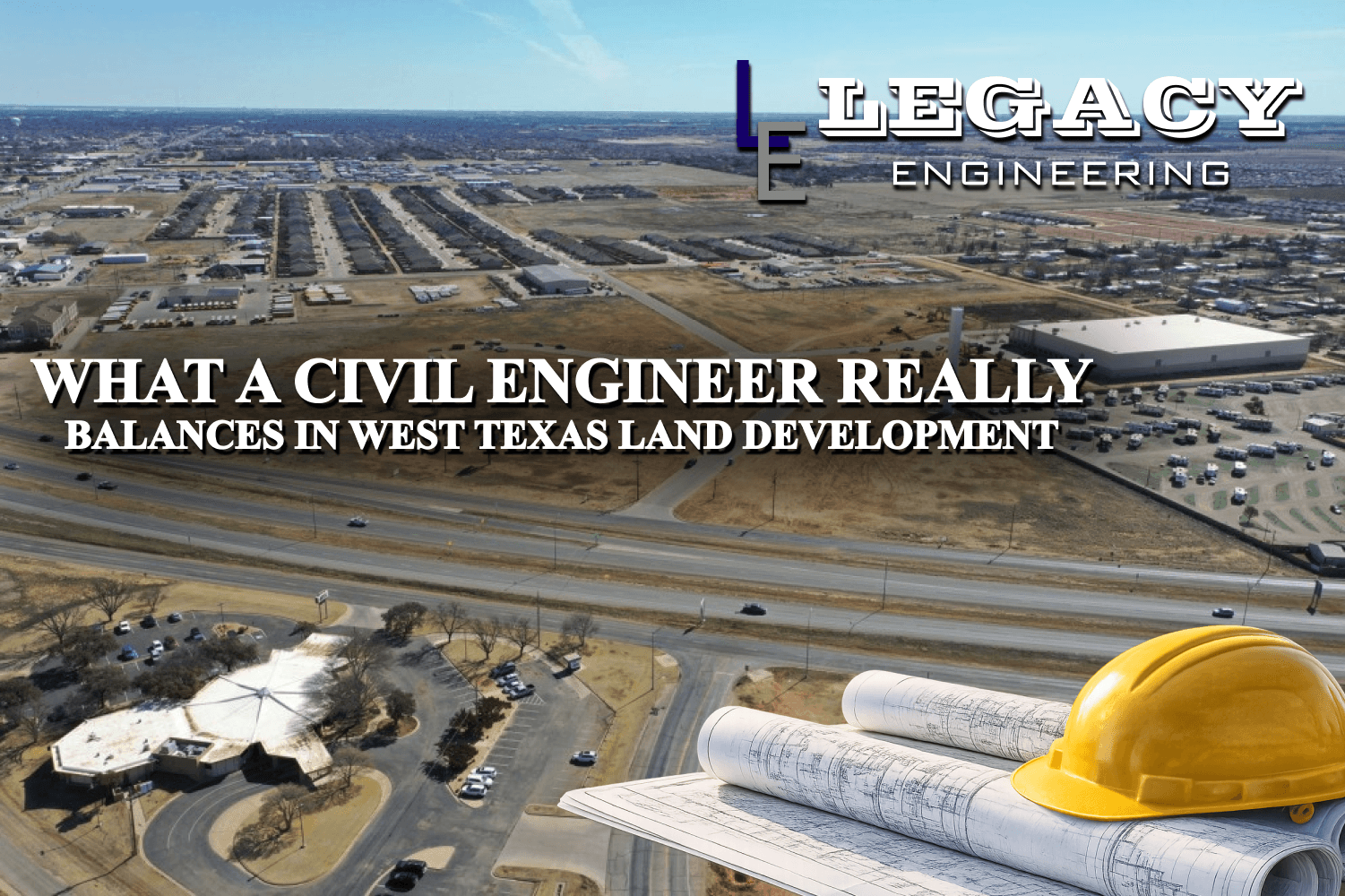
In West Texas land development, a civil engineer’s job is not just designing sites and infrastructure—it is balancing standards, regulations, drainage, groundwater, survey coordination, and fast-moving project schedules where a single delayed email or study can stall an entire development.
In West Texas, civil engineering is rarely about a single calculation or a single drawing. It is about balance.
Land development engineers operate at the intersection of land, regulation, infrastructure, and people. Every project must fit physical reality, satisfy multiple governing agencies, support a developer’s goals, and still protect the public and the surrounding community.
It is not a profession defined by one discipline. It is defined by coordination, judgment, and accountability.
And in a region like West Texas—where terrain is flat, soils are challenging, water is precious, and growth is steady—those tradeoffs become very real, very quickly.
Land development is not just “site design”
When people hear “land development engineering,” they often imagine a site plan and a subdivision layout.
In practice, land development is a process that begins long before any lots are drawn.
A civil engineer must first determine whether a property can be developed at all:
- Can it drain without creating downstream impacts?
- Can utilities reach the site?
- Can road access be provided safely and legally?
- Are there regulatory limitations that affect density, layout, or infrastructure?
In West Texas, where topography is often subtle and surface drainage can be difficult to define, these early feasibility decisions are frequently the most important part of the project.
Once a site is viable, the engineer must translate those constraints into a layout that works:
streets, blocks, lots, utility corridors, drainage corridors, and construction phasing.
This is not simply drafting. It is the process of fitting a project into a real physical and regulatory framework.
The survey side is foundational, not optional
Before a single engineering decision can be made, the land itself must be properly defined.
Civil engineers rely on licensed surveyors to establish:
- property boundaries,
- topography,
- easements,
- existing improvements, and
- legal control.
From an engineering perspective, survey information becomes the base layer for everything that follows.
Street grades, drainage patterns, utility depths, building pads, and right-of-way limits are all derived from the survey surface.
In land development, small survey errors or misunderstood boundary conditions can cascade into major design and construction issues later. Engineers spend a significant amount of time coordinating with surveyors to confirm assumptions, clarify limits, and verify conditions before moving forward.
Good projects are built on good survey data.
Coordination is a core engineering skill
Modern land development engineering is highly collaborative.
Engineers routinely coordinate with:
- planners and municipal staff,
- county reviewers,
- utility providers,
- roadway agencies,
- developers,
- architects,
- contractors, and
- survey teams.
Much of the engineer’s work involves translating between different technical languages—planning ordinances, construction methods, and regulatory standards—so that the project can move forward without conflict.
In West Texas communities such as Lubbock, Midland, and Odessa, development standards can vary significantly between jurisdictions. An engineer must understand not only what the rules are, but how they are typically interpreted by local reviewers.
The success of a project often depends on proactive communication as much as technical design.
Timing is just as critical as technical design
One of the least visible—but most important—parts of land development engineering today is timing.
Modern projects move fast. Contractors, developers, reviewers, and utility providers are often working on overlapping schedules, not sequential ones. In that environment, even small delays compound quickly.
In practical terms, this means that engineering is not only about producing correct plans—it is about keeping the entire process moving.
Not forwarding a review comment or coordination email for two days can easily push a project back two days.
Waiting too long to initiate a consultant scope can push a milestone back weeks.
A common example in West Texas development is groundwater and site suitability work. If a groundwater study or supporting documentation is not started early enough, the entire preliminary plat or development application can be stalled while that information is being prepared and reviewed. The engineering drawings may be complete—but the project cannot move forward without the supporting approvals.
This creates a different kind of responsibility for today’s civil engineer.
Engineers must anticipate which studies, permits, and agency reviews will control the project schedule and initiate those items early—often before the rest of the design feels “ready.” Sequencing work correctly has become just as important as producing the work itself.
In many cases, the success of a project schedule is determined not by how quickly plans are drawn, but by how early the right coordination and regulatory steps are started.
Roadway design today is often about standards and compliance
It is worth acknowledging a reality of modern civil engineering practice.
In many land development projects today, civil engineers are not redesigning roadway cross sections from first principles. Most cities and counties already have adopted roadway standards.
In practice, roadway design often starts with:
“Here is the standard section.”
That standard defines:
- pavement width,
- right-of-way width,
- sidewalk and parkway requirements,
- curb and gutter types, and
- typical structural sections.
Rather than engineering the cross section itself, the civil engineer’s role is to correctly apply those standards and ensure that the roadway layout, geometry, and profiles comply with the governing jurisdiction or agencies such as Texas Department of Transportation where applicable.
That does not make the work trivial.
Engineers must still evaluate:
- horizontal and vertical alignment,
- intersection spacing,
- sight distance,
- grading transitions,
- accessibility requirements, and
- constructability within tight site constraints.
The engineering challenge is no longer inventing the roadway—but fitting a prescribed standard into a real, imperfect piece of land.
The same reality applies to many other design elements
This shift toward standardization extends well beyond roadways.
Across most land development projects today:
- concrete mix designs are usually specified through standard construction specifications,
- structural and pavement details are often adopted typicals,
- subdivision construction details are standardized by each jurisdiction,
- and many utility installation details are prescribed by local providers.
Civil engineers are not typically inventing new concrete sections, curb details, or manhole designs.
Instead, they are responsible for selecting the correct standard details and verifying that those details are applied consistently and correctly throughout the project.
In other words, modern land development engineering is increasingly focused on compliance, coordination, and technical integration.
That responsibility is just as critical as original design.
Drainage remains one of the most technically demanding pieces
Drainage is where West Texas land development often becomes truly challenging.
Flat terrain means:
- limited available slope,
- shallow flow paths,
- limited ability to rely on gravity alone, and
- increased sensitivity to small grading changes.
Engineers must carefully model runoff and storage while balancing:
- on-site detention or retention requirements,
- downstream impacts,
- existing roadside ditches and channels,
- floodplain limitations, and
- long-term maintenance considerations.
In many developments, especially in fast-growing areas, drainage systems must function for decades in conditions that will change as upstream and downstream land is developed.
This is one of the areas where professional judgment still plays a major role, even within a framework of adopted drainage criteria.
Groundwater, wells, and on-site wastewater introduce another layer
When developments rely on water wells or on-site wastewater systems, civil engineers must work within the regulatory framework of the Texas Commission on Environmental Quality.
In those cases, engineers are required to coordinate or support:
- groundwater availability studies,
- site suitability constraints, and
- setback and protection requirements.
This brings hydrogeology, site layout, and utility planning together.
Even when specialists perform portions of the analysis, the civil engineer remains responsible for integrating those findings into the overall site design and ensuring regulatory compliance.
Read Groundwater Availability Studies (GAS): What Developers Need to Know to learn more.
The engineer’s real responsibility is managing risk
It is fair to say that today’s civil engineers in land development are not “engineering everything” in the way many people imagine.
But that does not diminish the role.
In fact, the responsibility has shifted.
The modern land development engineer is responsible for:
- ensuring the correct standards are used,
- confirming that designs comply with subdivision regulations and drainage criteria,
- coordinating between multiple agencies and disciplines,
- identifying conflicts before construction,
- and protecting the project from costly regulatory or constructability failures.
Every incorrect standard detail, missed setback, or misunderstood drainage requirement represents risk to the developer, the contractor, and ultimately the public.
The engineer is the professional charged with managing that risk.
Why this balance matters in West Texas
Land development in West Texas is shaped by:
- limited natural relief,
- challenging soils,
- intense rainfall events despite an arid climate,
- growing communities,
- and infrastructure that must remain affordable to build and maintain.
Civil engineers must continuously balance:
- regulatory compliance versus project efficiency,
- standardization versus site-specific constraints,
- construction practicality versus long-term performance,
- and development goals versus public responsibility.
This balance is not visible in a finished roadway or subdivision plat—but it defines the quality and durability of the built environment.
Closing
Civil engineering in West Texas land development is not about reinventing details or designing every element from scratch.
It is about making sure the right standards are applied, the right regulations are followed, the right professionals are coordinated, and the right decisions are made at the right time.
It is a profession grounded in accountability.
At Legacy Engineering, we focus on delivering land development solutions that respect local regulations, reflect real construction conditions, and support long-term community growth—so developers, municipalities, and builders can move forward with confidence.