
Developing a 10-Acre Tract in Lubbock County: What Developers Should Know Before Subdividing
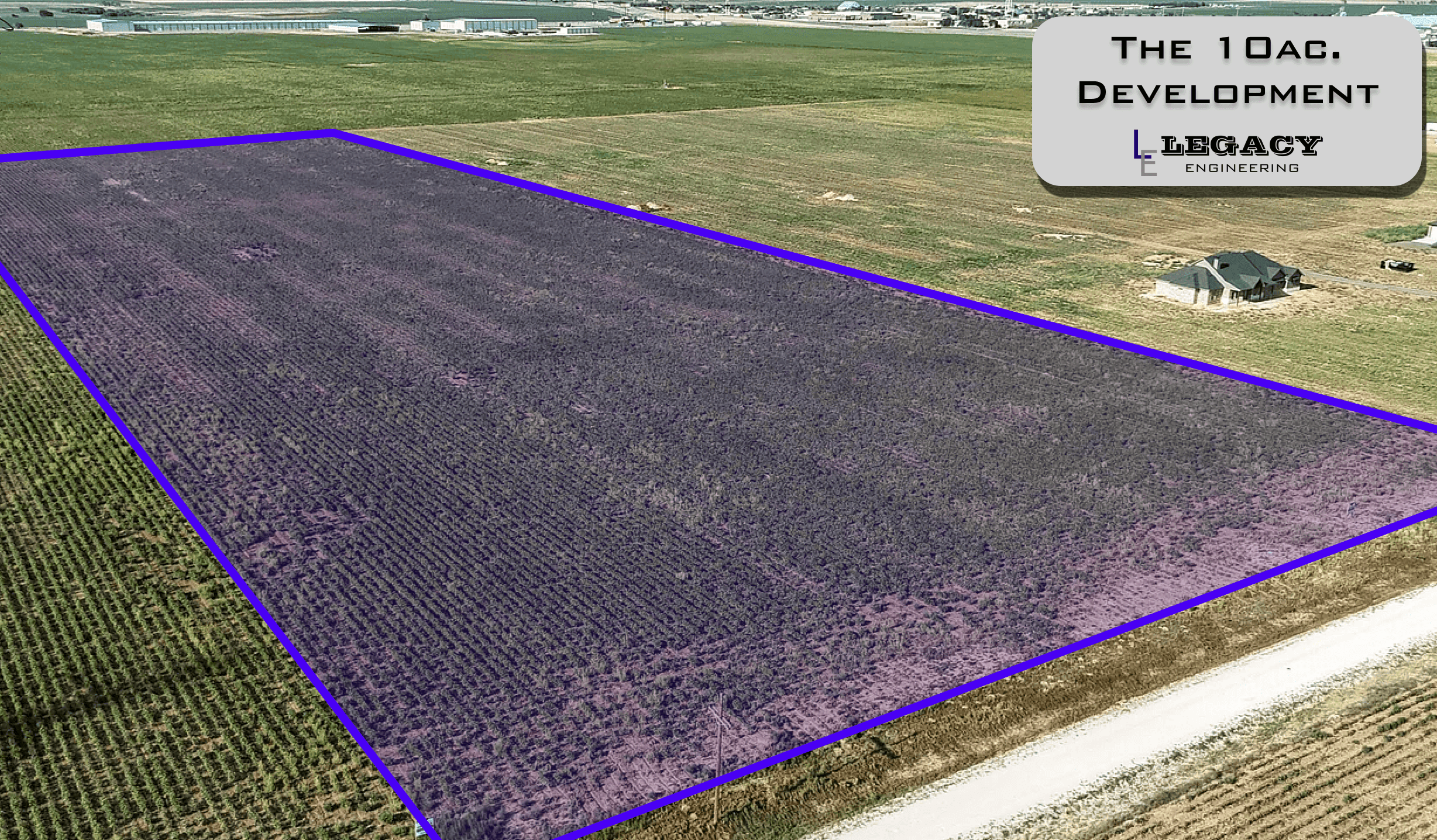
Developing a 10-acre tract in Lubbock County can be a great opportunity—but once you subdivide into one-acre lots, new platting, roadway, and groundwater requirements can significantly impact your project’s cost and feasibility.
Across much of Lubbock County, land has been subdivided into 10-acre tracts — and that’s no accident. Under Texas law, property owners can divide land into parcels 10 acres or larger without triggering formal platting requirements.
For many developers, these 10-acre tracts appear to be an ideal starting point. They are often located just outside city limits, are relatively affordable, and are large enough to be further subdivided into smaller one-acre residential lots.
However, the moment you decide to subdivide a 10-acre tract into smaller tracts, your project enters a completely different regulatory environment. At that point, your development becomes a platted subdivision, subject to county review, infrastructure requirements, and—beginning in 2024—a mandatory Groundwater Availability Report.
In this article, we outline several key items developers should understand before purchasing and subdividing a 10-acre tract in Lubbock County, Texas.
Platting
So, what exactly is platting—and why should developers care about it?
Platting is the formal process of subdividing land into smaller tracts or lots through a recorded document called a plat. The plat legally defines each lot, easement, access point, and right-of-way and becomes the official record of the subdivision.
In Texas, any subdivision that creates lots smaller than 10 acres must be platted. That is where the process becomes more involved.
Once a tract is platted, the local governing authority—in this case Lubbock County—must review and approve the subdivision. The County’s review ensures the proposed lots and improvements comply with subdivision regulations, including requirements related to:
- access and roadway design,
- drainage and stormwater considerations,
- utility provisions, and
- right-of-way dedication.
While purchasing a 10-acre tract does not require county approval, developing it into smaller residential lots absolutely does. Understanding this distinction early can save significant time and unexpected cost during the planning and due-diligence phase.
Developing a 10-Acre Tract in Lubbock County
In Lubbock County, the most common way to develop a 10-acre tract is to subdivide it into several one-acre residential lots.
Why one acre?
For most rural developments, the answer comes down to regulations from the Texas Commission on Environmental Quality (TCEQ). In areas without centralized utilities, individual lots typically rely on private water wells and on-site septic systems. Under TCEQ on-site sewage facility requirements, a one-acre lot is commonly used as a practical minimum to allow adequate space for both systems and required separation distances.
New groundwater requirements
Beginning January 1, 2024, a new requirement under Texas law mandates that any plat creating lots smaller than 10 acres must include a Groundwater Availability Report (GAR).
This report demonstrates that sufficient groundwater exists to support the proposed subdivision and must be submitted as part of the platting process. Developers should account for this requirement early, as it adds both time and cost to project schedules.
Access and roadway improvements
Once minimum lot size and utility strategy are established, access often becomes the most challenging—and expensive—part of a rural subdivision.
In Lubbock County, when land is developed through a plat, the developer is required to improve the roadway that fronts the property to current county standards.
The challenge arises when connectivity to existing improved roadways is considered. The County’s goal is to avoid “patchy” improvements—short sections of improved roadway separated by unimproved roads. To promote continuity and safety, developers are often required to extend roadway improvements until they connect to an existing improved roadway.
As a result, a relatively small 10-acre subdivision may be required to construct roadway improvements beyond the project’s frontage, significantly increasing overall development costs.
At Legacy Engineering, we have seen many projects struggle not because of poor planning or engineering design, but because of unanticipated roadway construction costs. Identifying these requirements early is critical for realistic budgeting and feasibility analysis.
Groundwater Availability Study (GAS)
As of January 1, 2024, any subdivision of land in Texas that creates lots smaller than 10 acres must include a Groundwater Availability Report (GAR) supported by a Groundwater Availability Study (GAS).
Prior to 2024, a groundwater study was often recommended, but it was not required by state law. Today, it is a mandatory part of the plat approval process for subdivisions relying on groundwater.
What the study involves
A Groundwater Availability Study is a short-term aquifer test used to confirm whether sufficient groundwater is available to support the proposed development.
In general terms:
- Two wells are used for the study,
- one well is equipped with a pump and monitoring equipment,
- the second well is used strictly for monitoring, and
- pumping and data collection occur continuously for approximately 48 hours.
The collected data is used to evaluate aquifer performance, drawdown, and long-term water availability. The results are then summarized in the Groundwater Availability Report submitted with the plat.
What this means for developers
If usable wells already exist on the property, those wells may be utilized for the study. However, if no wells exist within the project limits, two new test wells must be drilled, which can represent a significant up-front cost.
In most cases, developers are able to recover this cost during lot sales. Lots supported by a groundwater study provide buyers with confidence that water is available, and in many situations, the existence of a proven well on each lot increases marketability and value.
While the requirement does increase initial development costs, it often strengthens the overall project and reduces long-term risk for both developers and buyers.
If you wish to learn more, make sure to read out blog that dives deeper into this topic: Groundwater Availability Studies (GAS): What Developers Need to Know
Closing Thoughts
The development of 10-acre tracts throughout Lubbock County and the greater West Texas region continues to grow as developers look to create small rural residential subdivisions.
With new groundwater requirements and increasing roadway improvement obligations, understanding the full scope of subdivision development is more important than ever before purchasing and subdividing a tract.
At Legacy Engineering, we assist developers through every phase of the subdivision process—from early feasibility and platting to groundwater studies, roadway design, and construction coordination.
If you are considering purchasing or developing a 10-acre tract in Lubbock County or anywhere in West Texas, our team would be glad to help you evaluate your project and plan your next development.
Contact Legacy Engineering today to learn more about our subdivision and land development services.